How to Improve Work Efficiency: 12 Actionable Tips for Workplaces

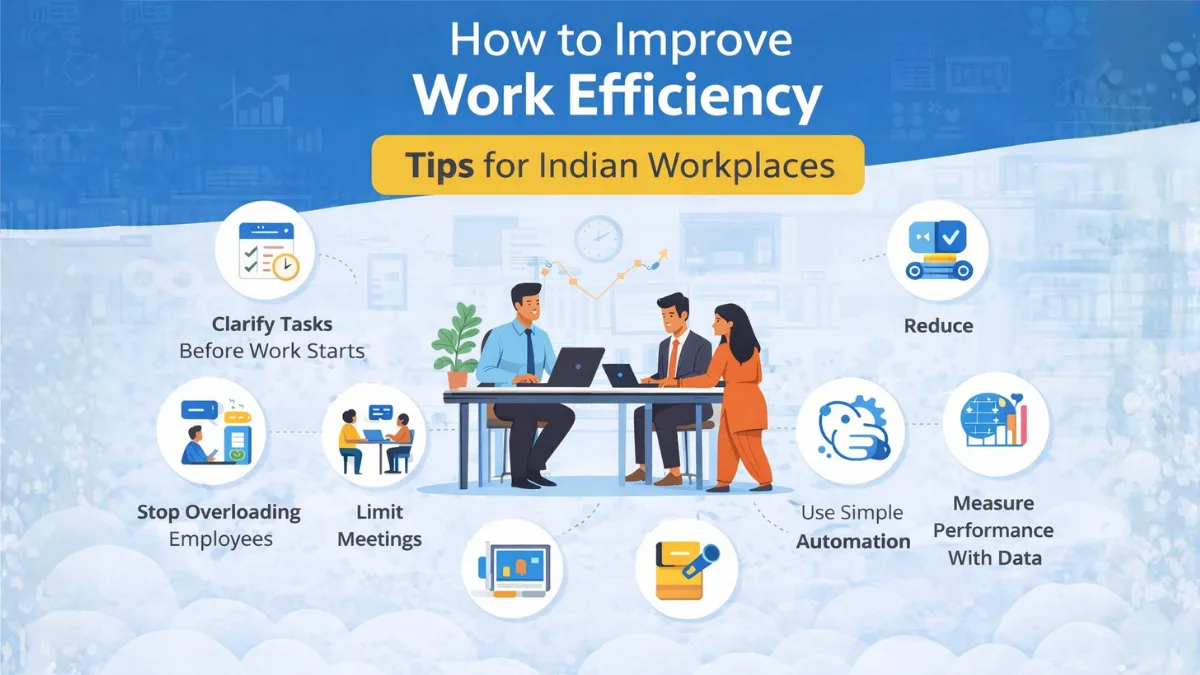
In most Indian offices, the problem isn’t that people don’t work hard; it’s that they work long, not smart. Employees stay late, attend endless meetings, and still deadlines slip. That’s not a productivity issue. That’s an efficiency problem.
Work efficiency means completing tasks faster, better, and with less stress. Whether you run a startup, manage a corporate team, or lead a small business, improving efficiency directly increases profits, reduces errors, and keeps employees motivated.
Improve Work Efficiency Today — Start Free
Let’s break it down in a practical, real-world way.
What Is Work Efficiency (Simple Meaning)
Work efficiency = More results in less time without lowering quality
Example:
- Employee A finishes 10 reports in 8 hours
- Employee B finishes 10 reports in 5 hours
Employee B is more efficient — not because they worked harder, but because they worked smarter.
Why Efficiency Matters in Indian Work Culture
Many Indian workplaces struggle with:
- unnecessary approvals
- slow decision-making
- multitasking overload
- manual processes
Improving efficiency helps companies:
- reduce operational costs
- deliver faster to clients
- improve team morale
- scale faster
In competitive markets like India, speed often decides who wins business.
Signs Your Team Is Not Efficient
If you see these signs, efficiency needs improvement:
- Employees are always “busy”, but results are slow
- Work gets delayed at the approval stages
- Too many follow-ups needed
- Same mistakes repeated
- Employees are tired but output is low
Efficiency problems usually come from systems — not people.
See Where Your Team’s Time Really Goes — Try It Free
12 Practical Ways to Improve Work Efficiency
1. Clarify Tasks Before Work Starts
Many delays happen because employees don’t fully understand instructions.
Instead of saying:
“Complete this soon.”
Say: “Finish this by 4 PM today. Include data from last month and send a PDF.”
Clear instructions save hours of correction later.
2. Stop Overloading Employees
Giving one person five tasks at once doesn’t increase productivity. It slows everything.
Indian managers often assume:
Busy employee = productive employee
Reality:
Focused employee = productive employee
3. Reduce Approval Layers
In many companies, work moves through 3–5 approvals. Each step delays delivery.
Solution:
Define approval authority levels. Not everything needs senior management review.
4. Use Simple Automation
Manual work wastes time.
Examples:
- automatic attendance systems
- auto reports
- email templates
- CRM reminders
Even small automation saves hours weekly.
5. Limit Meetings
Typical Indian office issue:
1-hour meeting → topic covered in 10 minutes.
Rule:
If meeting has no agenda → cancel it.
Short structured meetings improve efficiency instantly.
6. Prioritize Important Work First
Employees often start with easy tasks instead of important ones.
Teach teams:
Urgent + Important tasks first
Easy tasks later
This ensures key deliverables never get delayed.
7. Measure Performance With Data
Without measurement, efficiency can’t improve.
Track:
- task completion time
- output per employee
- delay reasons
- rework frequency
Numbers show real problems, not assumptions.
8. Train Employees Regularly
Many inefficiencies happen because employees don’t know faster methods.
Example:
An accountant using Excel manually may take 3 hours. With training in formulas, same task takes 40 minutes.
Training = efficiency multiplier.
9. Avoid Multitasking Culture
Indian workplaces often praise multitaskers. But research proves multitasking reduces productivity by up to 40%.
Encourage:
One task → complete → next task
Quality improves automatically.
10. Keep Communication Simple
Long emails, unclear instructions, and scattered WhatsApp messages create confusion.
Better approach:
- clear task messages
- single communication platform
- written instructions
Clear communication reduces errors and saves time.
11. Encourage Short Breaks
Continuous work reduces concentration.
Simple rule:
50 minutes work + 10 minutes break
Employees return sharper and faster.
12. Remove Unnecessary Processes
Some workflows exist only because “we’ve always done it this way.”
Ask regularly:
- Is this step required?
- Can we remove it?
- Can we simplify it?
Most companies discover that 20–30% steps are unnecessary.
Want Better Productivity Tracking? Get a Free Workforce Management Tool
Biggest Efficiency Mistakes Companies Make
Avoid these common management errors:
- micromanaging employees
- setting unrealistic deadlines
- unclear instructions
- poor delegation
- ignoring feedback
Efficiency improves when leaders fix systems, not blame teams.
Quick Self-Check for Managers
Answer honestly:
- Do employees ask for clarification often?
- Do tasks get delayed frequently?
- Do you follow up too much?
- Do reports contain errors?
If yes → workflow needs improvement, not employee replacement.
Long-Term Strategy to Build an Efficient Workplace
High-performing organizations follow this cycle:
Measure → Improve → Simplify → Repeat
Efficiency is not a one-time change. It’s a management habit.
Companies that consistently optimize workflows always outperform competitors who rely only on hard work.
Conclusion
Improving work efficiency is one of the fastest ways to grow a business without increasing costs. When tasks are clear, tools are modern, processes are simple, and employees are focused, output naturally increases.
Remember:
Success doesn’t come from working longer hours. It comes from making every hour count.
Boost Team Productivity Instantly — Try a Free Workforce Management Tool
Frequently Asked Questions (FAQs)
1. What is the fastest way to improve work efficiency?
The fastest way is to remove unnecessary tasks and clarify priorities. When employees know exactly what to do and what not to do, productivity improves immediately without extra effort.
2. How can managers improve team efficiency?
Managers can enhance efficiency by establishing clear goals, minimising unnecessary meetings, automating repetitive tasks, and monitoring performance metrics. Leadership clarity directly affects team output speed.
3. Does multitasking improve efficiency?
No. Studies show that multitasking reduces productivity and increases mistakes. Focusing on one task at a time produces faster and better results.
4. What tools help improve workplace efficiency?
Common tools include:
- project management software
- time tracking tools
- communication platforms
- workflow automation systems
These tools reduce manual work and streamline collaboration.
5. Why do employees work long hours but still produce less?
This typically occurs due to poor workflow design, unclear instructions, frequent interruptions, or unnecessary approvals. The issue is often process inefficiency, not employee performance.
6. How do you measure work efficiency?
Work efficiency is measured by comparing output with time and resources used. Common indicators include task completion time, error rates, productivity levels, and goal achievement.
7. Can improving efficiency reduce business costs?
Yes. Efficient workflows reduce wasted time, prevent errors, and minimize resource usage, which directly lowers operational expenses.
8. What is the difference between productivity and efficiency?
Productivity measures how much work is done, while efficiency measures how well it is done with minimal waste. A team can be productive but still inefficient if they use too much time or effort.
Recent Posts
|
Top Fintech Software Development Company in India — Why eFox Technologies Stands Apart 28 May 2026, Efox Team |
|
Best School Management Software in Bareilly 23 May 2026, Efox Team |
|
Best College Management ERP Bareilly 22 May 2026, Efox Team |
|
Best CRM Software Provider Bareilly | CRM-Fox 19 May 2026, Efox Team |
|
Best Employee Management System — Efox-Payroll 16 May 2026, Efox Team |
No comments yet. Be the first to comment!